
-

Al Baseer Hospital
- Sep 24. 2025
What are Hospital Acquired Infections (Like MRSA) and How Do Hospitals Prevent Them?
When my uncle was hospitalized after surgery, I noticed something amusing. Every nurse, doctor, and even janitor seemed to be cleaning, disinfecting, or washing something every two minutes. I thought to myself at first, "Is it really all necessary?" The short answer: yes. And the long answer? That's where the safety of hospitals comes in, because it becomes interesting.
Introduction: Establishing a Soothing Tone
When my uncle was hospitalized after surgery, I noticed something amusing. Every nurse, doctor, and even janitor seemed to be cleaning, disinfecting, or washing something every two minutes. I thought to myself at first, "Is it really all necessary?" The short answer: yes. And the long answer? That's where the safety of hospitals comes in, because it becomes interesting.
Hospitals exist to heal, but while healing, sometimes a patient can get an infection. These are called Hospital-Acquired Infections (HAIs). That does sound alarming, but the good news is you are not powerless. Hospitals view this risk extremely seriously and have complete systems in place to ensure patients do not get HAIs.
So let's take apart what HAIs are, why they happen, and more importantly, the robust safety nets that hospitals use to safeguard you and your loved ones.
What Are Hospital-Acquired Infections (HAIs)?
More simply put, a hospital-acquired infection happens during a period of treatment at a hospital or a medical facility.
Imagine your body is a sports team. The immune system is the manager of a protective lineup. The immune system manager is always preparing strategies. Unfortunately, there are periods of time when the manager has to shift focus. These periods are weak delays that provide the competitors a chance to score.
This, of course, doesn't make the hospital unsafe to visit. Rather, the hospital is paranoid to the extent that they have constructed strategies to make sure that all competing teams are unable to score.
Understanding MRSA Without Fear
You may be familiar with "staph." It's a form of bacteria that healthy individuals carry on their skin or in their nose without issue. Usually, it just keeps to itself.
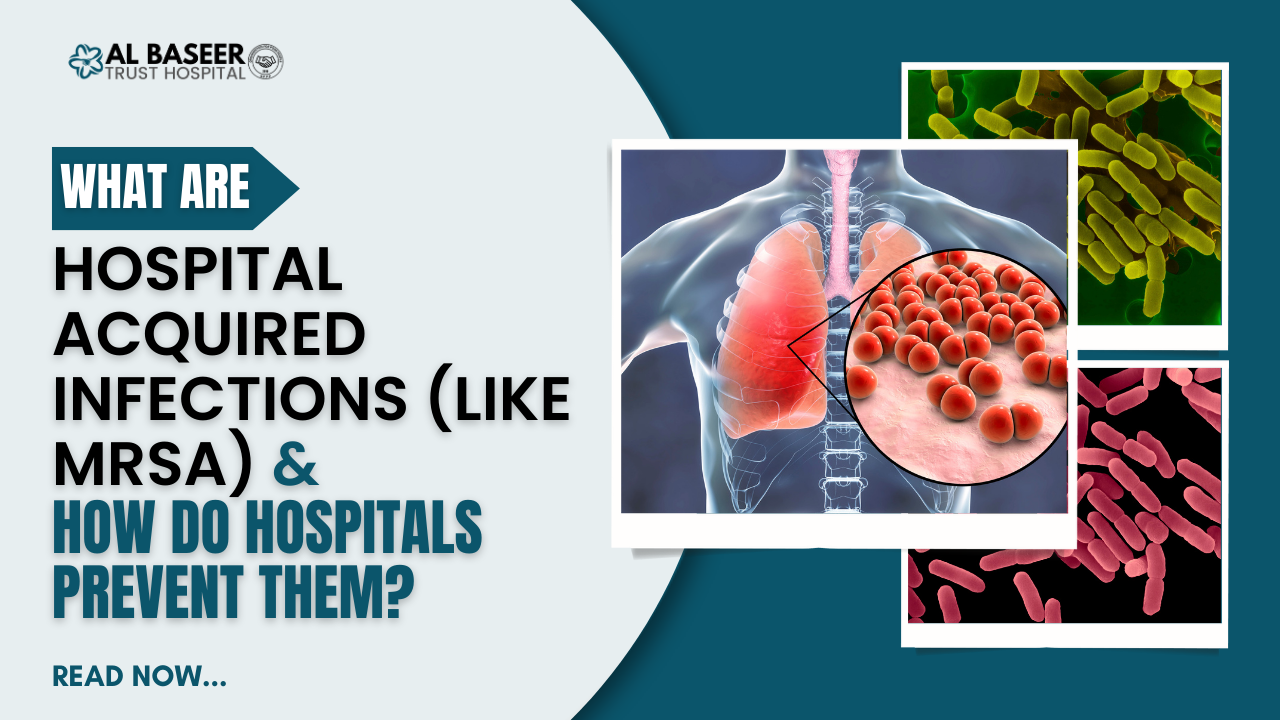
Now, MRSA is merely a strain of staph that has become resistant to certain antibiotics that are most often prescribed. Think of it as a germ that's become clever at outsmarting some of the medication that we normally take against it.
Here's the dirty little secret: For ordinary folk who are not in the hospital, MRSA is usually not a big deal at all. But in the hospital, where some patients' immune systems are weak, MRSA can be more problematic. That's why hospitals are so worried about it.
So, MRSA is not a lurking monster in the hospital; it's a known bug that hospitals actively endeavor to prevent daily.
The Hospital’s Multi-Layered Safety Net
Hospitals use more than a single defense. They have constructed an entire web of defenses, akin to a safety net strung out over several layers. Let's see how it operates.
Layer 1: The First Line of Defense Hand Hygiene
Hands are germ delivery trucks; they transport germs from one location to another. Because of this, hand hygiene is the single most effective infection-fighting tool.
You'll find alcohol-based sanitizer dispensers installed all over hospitals. That's not for dramatic effect. It's because washing hands before and after each patient contact halts germs dead in their tracks.
And here is something important: You're not hesitant to express your opinions. If you do get uncertain, it's perfectly okay to say, "Please wash your hands before examining me, thank you." This in no way whatsoever is rude; it shows that you are part of the care team.
Layer 2: Creating a Clean Zone Environmental Cleaning
Bacteria certainly love to celebrate on high-touch surfaces like bed rails, call buttons, and door handles, and tbh, it seems that cleanup operators are still stuck in the pandemic and follow checkpoints on computer screens, scrubbing surfaces with H monster-grade disinfectant, like really?
It is like calling in a high-tech cleaning team for a mop-up, keeping from heading to the exit without adding a pocket dimension to the hospital. Special machines with ultraviolet light are wheeled into the room for use after a patient is finally sent home. These machines zap and disinfect light waves to germs that even disinfectants miss.
Layer 3: Protective Gear and Sterilization
It's like armor with accessories, without the hassle of carrying a shield, and this is what every doctor and nurse puts on in order to emphasize the pair of gloves and the mask that sort of looks like a ninja's face. That is to say, no one is trying to make you feel grave; it is much more important to be properly suited on both ends.
In order to complete even more advanced procedures, every piece of surgical equipment and tool is left absolutely spotless, thanks to the intense processes that include heat, machines designed for this, and suppression. This keeps every surgery and procedure safer right from the start.
Layer 4: Intelligent Use of Antibiotics
No prescriptions for antibiotics will be given for just anything without needing a good reason. Why not treat them like sweets? The excess use of antibiotics can actually strengthen some of the bacteria, making them far from easy to eliminate. The approach taken can be referred to as responsible use of antibiotics.
Hospitals do not prescribe antibiotics 'just in case'. There is a tendency to protect the bacteria from evolving resistance.
How Patients and Families Can Help
And the best part? You're not a spectator; you can assist as well.
Remind the staff of hand hygiene if necessary.
Wash your own hands frequently, particularly before eating or handling wounds.
Inform sick visitors to wait until they feel well before visiting.
Monitor IV lines or catheters and inform staff if they appear sore or uncomfortable.
These little steps go a long, long way.
Conclusion: A Message of Confidence
Of course, no one enjoys the thought of HAIs, but hospitals take the concern very seriously and have built up multiple lines of defense in their battle against infection. Every step, from thorough handwashing to appropriate antibiotic use, is designed to protect patients and enhance the healing process.
The touchless systems, the protocols of cleaning and disinfection, the systems of routine hand hygiene, and the application of other infection control measures are proof of the vigilance the hospitals have to protect your well-being.
Your safety is carefully considered.
Leave a Replay
Please login to leave your comment




Comment (0)